Monday, April 25, 2011

Finding Cordelia in King Lear’s Fool


Since the late 1980s children have pawed over the colourful pages of a number of picture books looking for Wally, a little character dressed in his red-and-white striped shirt with cap and blue pants. He is hidden among crowds of people doing a variety of amusing things in various locations around the world.

Four hundred years ago Shakespeare gave the world his take on the already age old story of King Lear, legendary king of Britain. Its scenes have been pawed over by students and teachers alike trying to make some sense of it. Frustrated students daily curse the play and Shakespeare, and scholars like AC Bradley have alleged that the play contains "improbabilities" that "far surpass those of the great tragedies in number and in grossness."

This allegation, though understandable, is bold when it is made against one of the greatest of all English playwrights! But the reason that the play has not been understood, the reason that there appears to be so many improbabilities, is that we haven't been asking the right questions and we haven't been pawing over the pages looking for answers to the right questions.

When we look at what Cordelia says she will do, which her first words in the play draw our attention to and invite us to think about, and when we look at France's words which introduce an element of uncertainty in "where" they will go after they leave Lear's presence, in the same way as Kent's last words introduce uncertainty as to where he will be found, we have to consider that maybe, just maybe, Shakespeare hides France and Cordelia under disguises in the middle of the play!

I mean, when France says to her "Thou losest here a better where to find" original audiences could have immediately suspected that it might not be France because that's where they went in every other presentation of the legend!

For thirty years I have been pawing over the words of the play looking for clues in the words of the Fool and the Servant/Knight and Gentleman that would confirm my suspicion that Cordelia and France never left England, but stayed behind to serve their father, Lear, in the tragic circumstances which they and which the audiences saw coming!

People have seen me as being obsessed! I even had a promotional Cordelia doll made dressed in motley and coxcomb! They've laughed at me or just ignored me, because most of them haven't got a handle, nor do they want to get a handle on the text, let alone the texts of earlier presentations of the Lear legend. And audiences these days are so taken by the mad speeches of Lear and the gouging of Gloucester's eyes, they haven't got time for anything else. Nahum Tate couldn't stand the play so he adapted it and gave it a happy ending. Today, King Lear has to be one of the most frequently played of all Shakespeare's works, but it is constantly being adapted.


But I have had as much delight in reading King Lear as I have had in reading As You Like It and seeing Rosalind's disguise, or The Merchant of Venice and seeing Portia's, and I do want other people to enjoy reading it and seeing Cordelia’s disguise. In fact, I am convinced that there are probably so many more clues that I haven't yet seen, which others will show me once they begin to look, and so our reading will be even more delightful.

"Oh, but," people have protested, "Lear is a Tragedy", and they are right in recognizing that there are tragic elements of the play that caused it to be classified as a Tragedy in the 1623 Folio edition.
But on the title page of the 1608 Quarto edition of the play it is styled as a History and it is very evidently a contrast with the anonymous 1605 History of Leir.


And there is something very beautiful in Shakespeare's play that made it such that while it might have been a tragedy for Lear, yet it was not a tragedy for Cordelia, as one of Shakespeare's sources explored the legend and styled it (Tragoedy of Cordila). I will come to that beautiful element in due course.


If you want to understand King Lear and discover what Shakespeare did with his source materials, you might need to become somewhat familiar with them and you can do so by following the links to them in the right-hand column of this blog.


WHAT DID CORDELIA SAY?


We don't very often see much treatment of what Cordelia says. Oh, there's a lot of focus on her "Nothing!" and Lear's response, "Nothing will come of nothing" which sets in motion the whole play, but Cordelia says a whole lot more than that! As I mentioned above, she even draws our attention to what she will do/say by asking, with her first words in the play, an aside, "What shall Cordelia do/speak? Love and be silent." and "Then poor Cordelia! And yet not so; since I am sure my love's More ponderous than my tongue."

She seems to be saying that she is going to act in such a way that her love would be demonstrated without her speaking about it, for indeed, if she were to try to express how much she loved her father, words would fail her.

A little while later she says that "... what I well/will intend, I'll do't before I speak that you may/make known It is no vicious blot...." France will interpret her words as a "tardiness in nature Which often leaves the history unspoke That it intends to do". Cordelia's words "...what I well/will intend, I'll do't before I speak" could be taken to mean that she will do what she intends to do before she speaks again to Lear and to the audience. After this first scene, she will not appear again on stage until after the Fool has appeared and disappeared.

She does not say, "before I speak about it" but "before I speak"! She is going to "Love and be silent" and she's going to leave it to her father to know, "that you may know", what she has done (in the 1608 play) and "that you make known" (in the 1623 version). The difference between "may" and "make" in the two texts accounts for the different words of Lear at the end of the play after he says, "And my poor Fool is hang'd...." In the 1608 edition, Lear's "O, o, o, o" is his coming to the knowledge just before he dies of what she did serving him as his Fool, while in the 1623 edition, his last words "Do you see this? Look on her, look, her lips, Look there, look there!" is his attempt to "make it known" that her earlier refusal to flatter her father was "no vicious blot...."

It's evident that the people in Lear's world do not make the connection between Cordelia and Fool, but Shakespeare could have expected his audience to make it, if not before, certainly at the end of the play! The reason Lear's world did not make the connection will become evident later.

FINDING CORDELIA IN THE MOTLEY!

In my earlier posts to this blog I have explained how in the minds of the original audiences the "boy" who used to come at Lear's call for his Fool had forsaken him and followed Goneril as her young gentleman, leaving an opening for Cordelia to step into the motley. I have also explained how France appeared disguised as a Servant/Knight right after we learn of Kent's disguise as a servant. He is paving the way for Cordelia's entry as the Fool, giving out that she has gone to France which everyone in Lear’s world already believes! He is carrying half her "care and duty" towards her father.

When the Fool finally appears Lear says "How now, my pretty knave! How dost thou?" This description of the Fool as a "pretty knave" could immediately suggest a girl disguised as a boy! Shakespeare so uses the word in As You Like It and The Merchant of Venice both of which he had written and performed before King Lear.

The Fool chides Kent for his loyalty to Lear saying of Lear that "this fellow has banish'd two on's daughters, and did the third a blessing against his will". You will recall that Kent's last words before he went into disguise were "Freedom lies hence, and banishment is here" and "He'll shape his old course in a country new." As Kent turned his sentence of "banishment" around, so, we might see, has Cordelia in her disguise as the Fool. The Fool is saying that while Lear thought he’d banished Cordelia, he had in fact banished Goneril and Regan, and allowed Cordelia to stay behind too. Lear had told Kent, in Cordelia's hearing, "Hence, and avoid my sight!" which together with Kent's cryptic words might have suggested to Cordelia the possibility of simply doing the same thing. In the 1605 anonymous Leir there is that wonderful scene in France when the King of France and Cordella appear disguised before Kent's equivalent, Perillus, and Leir, and serve them all without Leir and Perillus knowing who they are until they reveal themselves. There they form a team and return with the French army to rout the British and reinstate Lear.

In Shakespeare's play there is a constant sense that some of the characters are familiar with the legend. Certainly the audience was! Thus Cordelia says, "That lord whose hand must take my plight". "Must" could suggest a sense that this is what happens in the folk legend and has to happen here, for there is nothing to suggest that either France or Burgundy are under any compulsion from Lear to take her plight. In fact, it was quite the opposite, Burgundy refused her and Lear tried to dissuade France from taking her! Later as she is leaving her sisters she says "I know you what you are; And like a sister am most loth to call Your faults as they are named." How does she know what they are and their faults? Was it not because she, and the audience, knew what the sisters were like in the legend? It was there that the sisters' faults were already "named", flattery, deception, attempted regicide and the like.

Now that she is no longer appearing as their sister, in fact, now that she is appearing as the all licensed Fool, she begins to warn against her sisters intentions which have already been mooted to us at the end of Act I. Hardly a minute has transpired since the arrival of the Fool when the Fool offers to teach Lear a speech and Kent calls it "nothing." The Fool asks Lear, "Can you make no use of nothing, Nuncle?" and Lear reasserts, "Why no, boy; nothing can come out of nothing." This was what he had told Cordelia earlier, and Fool now points to one instance when Lear makes use of nothing, and seems to take exception to the use of "boy" throwing it back at Lear calling him "boy" inappropriately and asking him if he knows the difference between a sweet and a bitter Fool.

It won't be too long in the play's sub-plot before we will see the banished Edgar going into disguise as poor Tom saying, "That's something yet: Edgar I nothing am" and if the audience had thought they saw Cordelia in the Fool's motley here, they could have it confirmed by the sub-plot then.

Lear is to stand for the bitter Fool that counselled him to give away his land, which could have suggested, to an audience familiar with the very opening scene of Leir, Skalliger, who is Oswald's equivalent in that version of the legend. Oswald will be revealed as the bitter Fool and Cordelia will be found to be the sweet one in motley. But Lear doesn't remember Skalliger's counsel and so he takes it as a personal attack on himself alone!

Fool will then point to Lear's folly in cutting his crown in the middle and sharing it between his two daughters saying, "thou hadst little wit in thy bald crown when thou gav'st thy golden one away. If I speak like myself in this let him be whipp'd that first finds it so."

We might well ask what crown the Fool had given away? If Cordelia is the Fool, however, she has also given away her crown, two in fact, because she could be in France wearing the French Queen's crown, and rightfully owning a British one! And perhaps the audience could have seen this as Cordelia saying that if any other fool wants to point out her folly, he is to be whipped for speaking truth. In two more speeches the Fool will complain of being whipped for speaking truth.

The expression "if I speak like myself in this" is similar to Duke Vincentio's comment to Lucio in Measure for Measure when, disguised as a friar, he says, "I protest I love the Duke as I love myself." "Myself" is understood by Lucio to be a friar just as here "myself" would appear to be the Fool. But "myself" actually was the Duke as it looks very much like "myself" here in Lear is meant to be Cordelia.

Further, in the anonymous Leir, when the King of France meets Cordella in England after she has been expelled from her father's presence, she is contemplating a simpler lifestyle. France is disguised as a Palmer or pilgrim, and he is so taken by Cordella that he wants to know of her if she would entertain a proposal from a King to be his Queen. She doesn't want to be mocked by the pilgrim but assures him that she wouldn't even marry the Monarch of the earth unless she loved him.

France assures her that being a religious person, he wouldn't want to hurt her by offering her false hope, and then he tells her, "Therefore in witness of my true intent, Let heaven and earth bear record of my words: There is a young and lusty Gallian King, So like to me, as I am to myself, That earnestly doth crave to have thy love...." Cordella thought that France was talking about someone who was just like him, but we know that France is in fact talking about his own love for her! In approximately the same place in Shakespeare's story, we have this statement made by Fool which could be seen as Cordelia's obscure way of speaking about herself and her folly in giving up her chance of an English crown and a French one. If anyone else should want to point her folly out to her, let him be whipped for speaking the truth, in the same way as Lear had only moments before threatened the Fool with the whip for speaking the truth.

It might seem strange to us that Lear would not have noticed a difference in his Fool and that it was in fact Cordelia who was now wearing the motley. But Lear and nearly everyone else in Lear’s world does not recognize his faithful Kent who is now disguised in his presence, and this kind of disguise of children from parents and wives from husbands is found everywhere in Shakespeare's plays as well as in the works of other playwrights of that era.

But, in fact, Lear does notice something different about the Fool, asking, "When were you wont to so full of song, Sirrah?" and the Fool explains "I have used it, Nuncle, e'er since thou madest thy daughters thy mothers..." which was precisely when Cordelia would have had to go into disguise in order to remain at court.

The Fool then asks for a schoolmaster to "teach thy Fool to lie, I would fain learn to lie." This, of course, was Cordelia's problem in the beginning. She lacked that “glib and oily art to speak and purpose not" that her sisters had, and if she is the Fool she could be having difficulty keeping her mind in the role of the Fool, because that involved deception for her and she is used to speaking truth. Truth was her dowry.

Next the Fool complains that Goneril and Regan will "have me whipt for speaking true," which can be compared with "Truth is a dog must to kennel; he must be whip't out, when Ladie oth'e brach may stand by the fire and stink." Cordelia, truth, is out, and Oswald, "dog" over and over in the play, stands by the fire inside. "Thou wilt have me whipt for lying," as here threatened, "and sometime I am whipt for holding my peace" as Cordelia was, in a sense, in the beginning when she said "Nothing" and like a sister refused to name her sister's faults.

The Fool, reflecting on the role of a Fool, then says, "I had rather be any kind of thing than a Fool," as if there were another option which Fool knew of and yet was deliberately not taking up. But the Fool would not be Lear who is now "nothing," "an 0 without a figure" in front of it, or a zero, precisely what Lear had made Cordelia. But if she has become the Fool she is "now" better than Lear who has rejected the title Fool and given away all his other titles leaving nothing!

Lear meets Goneril's accusation, that he is encouraging riots among his followers, with the question, "Are you our daughter?" But this follows immediately upon the Fool's words about the cuckoo. Lear, of course, is addressing Goneril, but the juxtaposition of the speeches could cause members of the audience to suspect that the Fool is Cordelia in disguise. Similarly, Goneril's response,
I would you would make use of your good wisdom,
Whereof I know you are fraught; and put away
These dispositions which of late transport you
From what you rightly are...
could be applied to Cordelia disguised as the Fool, except that the 1608 text begins the speech, with "Come sir...."

Lear then asks, "Does anyone here know me?" as if to say, Have I changed that much that I am not even recognized anymore?! Of course, the audience knows who Lear is, but the question that could have been in the audience's mind is, who is the Fool?

Lear next questions Goneril's identity with the words, "Your name fair gentlewoman?" But this question, like his earlier one "Are you our daughter?" is juxtaposed with a statement by the Fool - "Which they [Goneril and Regan] will make an obedient father" in the 1608 text, and "Lear's shadow" in the 1623. "Fair gentlewoman" is used sarcastically by Lear, but people might have seen the fair gentlewoman disguised in the Fool's motley at this time and be wondering at her name!

Following Goneril's further protest Lear determines to go to Regan with the words, "Yet have I left a daughter." Now the audience knows Regan’s heart already, both from Shakespeare's sources of the legend and Lear to this point, and they know Cordelia's intention also from the sources and from her earlier claims in this play, and could have been provoked to think of her and perhaps see her here in the Fool.

In the 1608 text Lear begins to speak of his folly in the way he treated Cordelia, and then a little later he says again, "yet have I left a daughter, whom I am sure is kind and comfortable". Think of the potential for dramatic irony here where Lear is thinking of Regan, but the audience knows Regan's heart and suspects that Cordelia is the kind and comforting Fool who is caring for Lear. Lear had hoped to set his rest "on her kind nursery."

In the 1623 text Goneril next calls for Oswald. She has to do this twice in the 1623 text, but only once in the 1608 text, before Oswald comes. In the 1623 text Oswald has already come on stage twice at the call for the Fool, once in the 1608 text. Could it be that these changes from the 1608 text to 1623 text reflect an attempt to show that Oswald is used to responding to the call for the Fool but not the call for Oswald, which is perhaps a name he has assumed now that he is no longer in Lear's service, his real name being Skalliger? Goneril accuses the Fool of being "more knave than fool" but the Fool will later reject the term "knave" and it will be well and truly plastered all over Oswald by Kent.

The Fool runs off stage after Lear, but not before saying:
A Fox, when one has caught her,
And such a Daughter,
Should sure to the Slaughter,
If my Cap would buy a Halter,
So the Fool follows after.
Robert Goldsmith tells us that occasionally the fool may have worn a fox tail behind. Antonio, the artificial fool in Middleton and Rowley's The Changeling, 1653, is apparently wearing a fox-skin. Lollio, his keeper, tells him: "I shall not forebear the gentleman under the fool; if you do; alas, I saw through your fox-skin before now."

The fox in the Fool's verse is a fool, the fool is a female, and a daughter! This could be viewed as the Fool speaking about the possible end of Goneril, but it is Cordelia in some sources, as well as in Lear, who is hanged, and not Goneril. In the hovel when Lear thinks he sees Goneril and Regan and wants to arraign them he protests saying "No, you she foxes." Lear will ask Cordelia, after she has given up the coxcomb, if he has "caught" her, and refer to himself and Cordelia as "foxes". After this Cordelia will go "sure to the slaughter". This verse is prophetic of the future of the Fool, Cordelia, who will be hanged by a halter because she stayed behind wearing the Fool's coxcomb or cap in an attempt to rescue her father.

In the last scene of Act I we see Lear, Kent and Fool, as they prepare to remove to Regan's place. We hear the Fool warn Lear that Regan will use him as kindly as Goneril has. The Fool claims, "I can tell what I can tell" which would perhaps remind the audience of Cordelia's words, "I know you what you are". The Fool then speaks of spying into what one cannot smell out, which is very much like the disguised Autolycus' words to the Shepherd, in The Winter's Tale, "receives not thy nose court-odour from me?" Lear again speaks of having done Cordelia wrong. The Fool then reverses normal procedure, testing Lear in the manner that real lack wits were questioned, and then suggests that Lear would make a good Fool!

The Servant, who I am maintaining is France in disguise, enters and confirms that the horses are ready for the trip to Regan's. Later when disguised as a Gentleman he will identify himself to Kent as "one minded like the weather most unquietly." It could be that here he has been out gathering intelligence and waiting for news of the arrival of his forces from France. We will learn a little later from Gloucester's report of the letter he has received that there is only "part of a power already footed" or landed in Britain from France. From a worried look on France's face, Cordelia could surmise that there has been a delay in the mustering and transportation of his troops.

Lear continues to call the Fool "boy" which leads to the Fool's couplet, asserting her femininity with "she" and maybe voicing the worry that she is reading on France's face, that the French forces need to get to Britain faster or else they will die.
She that's a maid now, and laughs at my departure,
Shall not be a maid long, except things be cut shorter.

These days the maid in this couplet is usually thought to be a reference to any young virgin in the audience, who doesn't appreciate how dangerous the situation is, who would lose her virginity unless men's penises are cut off. But from Leir we learn that the celebration of Cordella's marriage to France would not be until they got back to France, and so Cordelia is still a maid.

The maid in this couplet could be Cordelia. The words "laughs at my departure" could be a reference to Oswald's giving up the motley, leaving an opening for her to fill, or it could be a reference to the Fool's departure from the play after saying, "And I'll go to bed at noon." If the latter, it would not sadden the Fool, Cordelia, that the motley Fool is gone because, since she has been the Fool, she can then take up her role as Queen of France. There was usually laughter when a Fool appeared on the scene and disappointment when he departed not to return. However, Cordelia won't be a maid for long after her departure from the stage as Fool, "except things be cut shorter", that is, unless the time taken for additional forces to get to Britain is shortened, because only a portion of the French troops needed has landed.

I used to think that the words "except things be cut shorter" were referring to a passage in the Bible with which King James I would have been familiar, but I'm not so sure of that at the moment.

Let me thank you for bearing with me in having read this far. As I said at the end of my last post, there are not a few clues that Shakespeare gives us that lead us to identify Cordelia in the motley. So far we have only dealt with the possible clues in Act 1.

In my next post I hope to detail the clues that I see in the next two Acts. To express an interest in receiving notice of the next posting please either follow my Twitter tweets @auusa or follow this blog. If you have any comments you wish to make, please do not hesitate to do so either below or via Twitter. I am more than willing to receive your critiques. Again, I am sorry if there is a bit of repetition in my posts, but I find it hard to make it understandable without repetition.

To see my basic justification for understanding the disguises of Cordelia and France see my previous postings below.

Monday, April 18, 2011

Shakespeare’s Fairytale Princess found in a hovel!

It was during Christmas New Year break that I was enjoying the company of two of my grandchildren and they both wanted to ride with me to the mall in my two seater van. Only one could, of course, so I playfully asked which one loved me the most. I said, "Do either of you love me up to the sun and back again?" My nine year old grandson swept his arm up and down several times to indicate that he loved me as much as several trips to and from the sun, while my seven year old granddaughter, who has twice been to Brazil, protested that she loved me more than that, "I love you up to the sun and back and then over to Brazil and around and around Brazil lots of times, and then back to Australia and around Australia lots of times!" I don't think either of them knew which one had professed the greater love, but I sure enjoyed their excited competition! I assured them that I loved both of them very much also, but since there was only one spare seat in the van they would probably enjoy riding together in Nana's car, which they did!

Putting this question of love playfully to my little grandchildren brought again to my mind the story of King Lear, one that has often been on my mind for more than thirty years.

We do not come to Shakespeare’s King Lear today with the same expectations as the original audiences, King James I and perhaps his family or the public at The Globe. Most people today come with an expectation of a celebration of darkness, madness and the death of the man more sinned against than sinning.

Yet, I am persuaded that originally the focus was not so much on the aged king, as it was on his daughter Cordelia and the King of France who, I am maintaining in this blog, both went into disguise in order to attempt to rescue Lear from the evil daughters and sisters.

It’s highly likely that original audiences would have expected, in Cordelia, a beautiful princess who was highly sort after by the King of France. While Shakespeare doesn’t comment on her beauty in the opening scene, yet there will be a tender description of her beauty later in the play from the lips of the Gentleman who talks with Kent. He spoke of her “delicate cheek” with “happy smilets that played upon her ripe lip” and “the holy water from her heavenly eyes”.


Like Cordella, her counterpart in the earlier (1605) anonymous play The True Chronicle History of King Leir, Shakespeare’s Cordelia would have come with a physical beauty that rivalled her older sisters’ looks. In Leir, Gonorill complains to Ragan of Cordella saying, “... she is so nice and so demure; So sober, courteous, modest, and precise, That all the Court hath work enough to do, To talk how she exceedeth me and you.” When the King of France first meets Cordella, before he knows her identity, he describes her as the “fairest creature ... that ever any mortal eye beheld.” According to another of Shakespeare’s sources, the 1574 edition of The Mirror for Magistrates, men judged Cordila “fairer by far” than her sisters who despised her grace and gifts and sought to assuage the praise men were giving her.


On reading these descriptions of Cordelia in the sources one is left with a strong reminder of the fairytale Cinderella and her two ugly sisters, and even though it is Cordelia’s virtue rather than her beauty that France seizes upon, yet there can be no doubt that Cordelia would have appeared in the minds of original audiences as a beautiful, fairytale princess who was to become the Queen of France. And this is the way she appears at the end of the play as well, after her supposed return to Britain from France as Queen of France, beautiful.

But there is an important aspect of the story of Cordella in Shakespeare’s source that we have not acknowledged in Shakespeare’s King Lear. In Leir there is that brief time of deprivation she feels after she is disinherited when she wanders out into the countryside still in her royal robes which she contemplates selling in exchange for garments more suited to her now meaner state. However, her meaner state does not get in the way of her contemplating the joy she will feel in her marriage to a Palmer or pilgrim, for so France is disguised when he finds her. France tells her that “There is a young and lusty Gallian King, So like to me, as I am to my selfe, That earnestly doth crave to have thy love”, and so from this lowly state he takes her to be his Queen.

Further, in coming to Britain in disguised as a pilgrim in pursuit of a bride, France takes with him his servant Mumford who persists in addressing him as “My Lord” which causes France to complain that they will be taken as spies if he persists.

Cordella does not have anything to do with her father Leir for several years until he comes to France with Perillus his servant to escape the wrath of the evil sisters. France and Cordella are out walking through the French countryside disguised “like a playne country couple” and come across her father and Perillus. France tells Cordella not to reveal herself to her father until they know the grounds of all the ill.

Leir is near to death from starvation, which Cordella and France relieve by feeding him all without his realizing who they are. Cordella wishes to reveal herself to her father but France suggests that she “Forbeare a while, untill his strength returne, Lest being over joyed with seeing thee, His poor weak sences should forsake their office, And so our cause of joy be turn’d to sorrow.”

As well as reminding us of the words the Gentleman will speak to Cordelia in Shakespeare’s play, the Gloucester sub-plot is also foreseen here. Edgar, disguised as Poor Tom is reluctant to reveal himself to his blind father until he was armed against the possibility of his father’s wrath, and then when he does so, the shock is too great for the aged Gloucester who has a heart attack and dies!

Also, the connection of the Gloucester-plot with Sir Phillip Sidney’s account of the “story of the Paphlagonian unkinde king” has been readily seen, but a connection with the Lear plot has not been acknowledged, even though Sidney’s account is the story of a king and not just an earl. Two princes, Pyrocles and Musidorus, hiding in a rock cave during a fowl storm, at the end of the storm see the blinded king of Paphlagonia passing by led by his son, Leonatus, and they hear the father telling the son to leave him to die and to get on with his own life. What interests me is the mention of the Princes stepping out of their shelter in such a way that they might “see unseen.” A little further in the story the bastard son, Plexirtus, who had put out his father’s eyes, came out to look for Leonatus to kill him. He wanted to make sure that the deed was done and so wasn’t prepared to just send someone to do it, but he came himself and story tells us that in doing this Plexirtus “therefore came him selfe to be actor, and spectator.”

This is the situation that France and Cordella found themselves in as they served Leir in the French countryside while disguised “like a playne country couple”. They were disguised from Leir when they heard his story and in this way they could “see” while their true identities were as yet “unseen”. They, like Plexirtus, were also in the situation of being “spectators”, in their case, of the misery of Leir, at the same time as they were “actors”, or having a part of the action, in their case, in providing sustenance for their starving father.

So Shakespeare’s hiding Cordelia in the Fool’s motley and disguising France as a Servant or Knight and a Gentleman, would allow them to “see unseen”, to be both “spectators” of the plight of Lear and “actors” in guiding him towards the troops France has arranged to come in at Dover.

And thus, the beautiful fairytale princess Cordelia disguised as the motley Fool, got to be with her father and Kent and Edgar in the hovel adjacent to Gloucester’s castle.

There are not a few clues that Shakespeare gives us that lead us to identify Cordelia in the motley. These are too numerous to be discussed in this posting, but will be dealt with in postings to follow. To express an interest in receiving notice of the next posting please either follow my Twitter tweets @auusa or follow this blog. If you have any comments you wish to make, please do not hesitate to do so either below or via Twitter. I am more than willing to receive your critiques. I am sorry if there is a bit of repetition in my posts, but I find it hard to make it understandable without repetition.

To see my basic justification for understanding the disguises of Cordelia and France see my other postings.  You can follow this blog or follow my Twitter tweets.

Thursday, March 31, 2011

King of France dies in attempted rescue of Shakespeare’s King Lear

It seems that forever, nations have honoured their heroes of war with Victoria Crosses, Purple Hearts and the like medals. These are often awarded posthumously, so they are not so much for the benefit of the soldier as they are for the comfort of the bereaved and the edification of the nation. Concern for the safety of their fellow soldiers or for the ultimate victory in the battle often leads men to act bravely in the face of grave danger. Stories of heroism and courage, of loyalty and self-sacrifice, and of ordinary men caught up in extraordinary circumstances, are rightly celebrated for many years thereafter.

There have been perhaps many hundreds of soldiers in many battles who acted with valour equally deserving recognition and honour about which no one knew, or else those who knew of these acts of bravery never got around to reporting them.
Then too, there have been fictional characters who are recognized for their repeated bravery in the face of danger that saved the day for western towns, city streets or battle platoons. We love their stories just as if they were real, and their examples can be an inspiration to us! But what if there was an act of courage and self-sacrifice in a fictional work that had gone completely unnoticed? How would we feel about that?
In Shakespeare’s King Lear when Cordelia and Lear are taken as captives after the failure of the French forces to reinstate King Lear on his throne, Cordelia says to her father:

We are not the first,
Who with best meaning have incurr’d the worst:
For thee oppressed King am I cast down
My selfe could else out-frowne false fortunes frowne.
Shall we not see these daughters, and these sisters?

Earlier in the play Edgar had reflected on what the “worst” would be when he said, “And worse I may be yet. The worst is not so long as I can say ‘This is the worst.’” In other words, the worst is when I have been defeated and am dead. 

Cordelia’s “We are not the first, who with best meaning have incurr’d the worst” could then perhaps give us the feeling that worse might lie ahead for her and her father, which turns out to be the case. But, according to Cordelia, someone has already suffered the worst in death, and she says that it was “with best meaning”!

Who has died to this point in time in the play? Cornwall has at the hands of his servant and that servant was slain by Regan. Cordelia’s intelligence could have known of Cornwall’s death, but it is doubtful if she would have considered his action to have been “with best meaning”. If she knew of the death of the servant she might have regarded his death as stemming from his “best meaning”.

There was, however, someone else much closer to Cordelia who I believe has died in the battle between French and British forces, namely the King of France himself. Disguised as a Gentleman he had gone off to the bloody arbitrement between the British and the French and never came back. 

To this point in time, so far as I know, no one has recognized the courageous service France rendered his fellow king, King Lear, which resulted in his death in battle, but it is there in Shakespeare’s play, as we will see.

For most readers of King Lear, France was last seen on stage at the end of the first scene when he promises Cordelia, “Thou losest here, a better where to find.” It is assumed that he returned to France with his new Queen and then some time later came back to Britain with his troops, only to make a hasty personal retreat home again because of “something he left imperfect in the state”. It has been assumed that he left his Queen Cordelia with her father and the French troops under the leadership of the Marshall of France, Monsieur La Far. 

Considering his claim in the opening scene that “Love’s not love When it is mingled with regards that stand Aloof from th’entire point”, I find it hard to believe that he would bring Cordelia back to Britain and simply leave her alone with an inadequate defence no matter what imperfections there might have been back in France. 

But going back to the words “Thou losest here, a better where to find”, the “where” is interesting because it suggests that it might be that he would not take her back to France. In the earlier story of Leir, Cordella is banished from her father’s sight and wanders around the British countryside until the King of France goes disguised as a pilgrim to Britain, finds her, and takes her back to France as his Queen. Some time later when the older daughters show their true colours toward their father, Leir and Kent’s equivalent, Perillus, go over to France to escape their evil. France and Cordella are out walking through the French countryside disguised “like a playne country couple” and come across her father and Perillus.

Leir is near death from starvation, which they relieve by feeding him without his realizing who they are. Leir then reveals himself to them and tells of his mistake in accepting his older daughters’ professions of love and rejecting his youngest daughter. Cordella and France then reveal themselves to Leir and there is a wonderful scene of reconciliation with each kneeling before the other asking a blessing. After a period of time during which Leir recuperates, France musters his troops, crosses over to Britain, routs the British forces and restores Leir to his kingdom.

So when in the beginning of Shakespeare’s play France says “Thou losest here, a better where to find” the audience could have been suspicious of their possibly not going to France. A few moments before Kent had spoken ambiguously of his determination to “shape his old course in a country new” and the next time we see him he is disguised and is reaccepted into the service of Lear as his servant.

Cordelia’s words to her sisters indicate that she is aware of what they are about to get up to, and so there would be an immediate need for Lear to be helped which could be achieved by France and Cordelia going into disguise and guiding him towards French troops at Dover.

In this blog I am contending that Cordelia puts on the Fool’s motley to be with her father and I am also saying that France goes into disguise as a Knight (in the Folio) /Servant (in the Quarto) and then as a Gentleman to accompany Cordelia, caring for her and helping her care for her father. Knights, Servants and Gentlemen and even Ladies are all acknowledged disguises for other characters in speech prefixes or tags, stage directions and speeches themselves in Shakespeare’s King Lear. In the Quarto and Folio editions of the play, individual characters can have multiple speech tags and designations in stage directions.

It seems to me that if France and Cordelia do not serve Lear in disguise, then a truly wonderful element of the old story has been ditched from the main plot and, indeed, transferred to the sub-plot! What I am saying is that Shakespeare has France and Cordelia go into disguise without announcing it, as Kent and Edgar do, and introduces the Gloucester plot to mirror what the audience could have discovered in the main plot.
So, I am saying that when Lear calls for his Fool, it is in fact the disguised France who proffers: “Since my young Lady’s going into France, Sir, the Fool hath much pined away.” Everyone in Lear’s world, including Lear, obviously believed that the King of France and Cordelia had gone to France, but the way this Knight / Servant speaks to Lear is surprising to Lear who responds “Ha! Say’st thou so?” 

Later in the play, Edgar will be disguised from his brother Edmund as a knight, and Edmund will speak of the breeding which his tongue breathes as being indicative of his courtliness. If we look closely at the words of this Knight / Servant in the beginning of the play we can appreciate the courtliness of the language and that the concerns are those a king might have, not a servant!

When the Servant says “Since my young Lady’s going into France, Sir, the Fool hath much pined away” Shakespeare is employing the plot devise of the false report as he does in other parts of this play and other plays. We have already seen Edmund’s deception of his father over the contents of the “letter” that Gloucester concludes was from Edgar, and Shakespeare employed it marvelously in Measure for Measure.
The Fool, Cordelia so disguised, then enters and begins to serve her father in that capacity and she is accompanied from time to time by France in disguise. France wanders off gathering intelligence and perhaps looking for news of his army’s progress towards Britain. I believe he sent back to France for his army to come in at Dover in much the same way that Caius Lucius sent back to Gallia for his Roman army to come in at Milford Haven in Shakespeare’s version of Cymbeline.

No one notices the disguises of France and Cordelia, but strange things happen, like Kent getting a letter from Cordelia who in such a short space of time has heard about Kent’s “obscured course” and would “find time from this enormous state, seeking to give losses their remedies.” It is a “miracle” to Kent, and to the reader, that not only has Cordelia learned of Kent’s disguise and care for her father, but she has managed to get a note to him from France! Kent is so full of himself and looking for his reward in Shakespeare’s play, but he’s not as boastful as Perillus was in Leir. If there is any doubt in your mind about Kent’s boastfulness, just consider Edgar’s report of Kent’s report to him of his service of Lear. 

There is also wonderful irony in Act 3 when Kent meets the Gentleman, who was with him earlier. Kent says he knows him, but the Gentleman does not tell him his name when asked, referring to himself simply as “one minded like the weather, most unquietly.” I believe that this is France, and Kent proceeds to tell him that France has spies who have seen into the Dukes’ activities and have secret feet ready to show their open banner! Kent reveals that he himself is much more than his disguised outfit would suggest and gives this Gentleman a purse containing letters, and a ring to pass on the Cordelia, assuring him that he would see her! He tells the Gentleman that by doing this he could improve his rank in society. The giving of purses and rings was often a sign of irony associated with disguise in Shakespeare. France extends his hand to Kent and questions whether he has no more to say to Cordelia than to reveal himself and his service to her. Kent has become dislocated from his master, Lear, whom he was supposed to be escorting to Dover, and he and France go off in opposite directions to try to find him.

In the Quarto’s Act 4 Scene 3 Kent meets up with this Gentleman again and asks him why the King of France had gone back home so suddenly. His words “know you no reason?” were calculated to be ironic not unlike the irony of Lear’s earlier words, “Ha! Say’st thou so?”

To Kent's question about whom France left as General in charge of the French forces, the answer is given, "The Marshall of France, Monsier la Far." This is France having a go at Kent! In Love's Labour's Lost we find someone being called "Monsieur the nice" which has an obvious meaning. Zinevra, of Baccassio's The Decameron, who lies behind the character of Imogen, takes on the disguised name "Sicurano da Finale", which can be roughly translated secure at last, expressive of her feeling of security. "Monsieur le Fer", the name of the French Soldier in King Henry V is clearly chosen for Pistol to respond to with "I'll fer him, and firk him, and ferret him....” Here in Lear "Monsieur la Far" suggests someone who is afar off as opposed to standing in his presence, and is France's way of playing with Kent who still does not recognise him, in the same way the disguised Vincentio plays with Lucio in Measure for Measure. The description of Cordelia's ripe lip in the Quarto which, "seeme not to know, What guests were in her eyes" would, perhaps, be meant to reflect on Kent's not knowing what guest (France) was in his eyes – the Quarto’s "seeme" is present tense.
The mention of Cordelia’s ripe lip suggests that this is France contemplating kissing his Queen’s lips. They have not yet consummated their marriage. Cordelia is still a maid. It is the language of love, and if it is not France, then one might wonder at the fantasies of this Gentleman.

After the disappearance of the Fool and the reappearance of Cordelia, there is concern because Lear has wandered off and is lost. It is the Gentleman with some attendants who find him and the Gentleman says “O! Here he is; lay hand upon him. Sir, Your most dear daughter--”. These words and the accompanying words of respect and care, could remind one familiar with the old play of The King of France’s words to Leir “she is your loving daughter, and honours you with as respective duty as if you were the Monarch of the world.”

In the Quarto version of the play, Kent meets this Gentleman for the last time as he goes off to join his army in the battle against the British. Kent still does not know him so France has fun with him again. After asking who is conductor of the slain Duke of Cornwall’s army, which echoes Kent’s earlier question as to whom the King of France has left in charge of the French forces, the Gentleman suggests that it is reported that Edgar and Kent are in Germany. Kent assures the Gentleman that it is time to look about since he knows he is about to reveal his true identity. The Gentleman has been looking about and seems to know that the French forces are not of sufficient number or strength to win the battle and so his last words in the play are “The arbitrement is like to be bloody...” which was predictive of his own death in the battle.

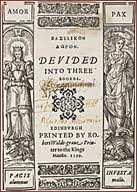
And so we return to where we started this post with Cordelia’s “We are not the first, Who with best meaning have incurr’d the worst...” which I am saying is Cordelia’s lamenting the sacrifice which France has made in dying for his fellow king. The “best meaning” picks up a theme that runs right through the play which we can find expressed in King James I own work, Basilikon Doron, in which he give his son instruction about how to be a good Christian king.
Use all other Princes, as your brethren, honestly and kindly: Keep precisely your promise unto them, although to your hurt. Strive with every one of them in courtesy and thankfulness: and as with all men, so especially with them, be plain and truthful, keeping ever that Christian rule, "to do as ye would be done to:" especially in counting rebellion against any other Prince, a crime against your own self, because of the preparative. Supply not therefore, nor trust not other Princes’ rebels, but pity and succour all lawful Princes in their troubles.
France's attempt to put down the rebellion against Lear and reinstate him in his kingdom was to France's hurt and I have suggested that it is France's death that Cordelia is mourning when she says at “We are not the first, Who with best meaning have incurr’d the worst...”

To see my basic justification for understanding the disguises of Cordelia and France see my other postings.  You can follow this blog or follow my Twitter tweets.

Wednesday, March 23, 2011

A female Fool? Cordelia?! But what became of the other Fool?

jessica said...

I just have some questions..

If Cordelia became King Lear's Fool what happened to the original Fool that Lear was used to coming into his presence when he called for him? And wasn't the Fool a boy? And wouldn't Lear have noticed that it was his daughter?

thanks.


Thanks for your questions Jessica.


In the plays of Shakespeare's day two types of Fools were represented. Indeed, they were present in real life too!


There were what we might call simple people, people who were socially challenged, who needed the patronage of Kings, Dukes and the like to survive and who provided their patrons with entertainment, a reason to laugh, in return for their patronage! There's a very good example of this kind of "Flat Fool Natural" in Jack Oates whom Robert Armin wrote about in his Foole Upon Foole or Six Sortes of Sotes published in London in 1600. (Full text can be found via Google)


Like many people who are socially challenged today, these Fools could say the most embarrassing things to their patrons and others, speaking the truth about them as they saw it. Like Jack Oates, they got away with saying things to their masters that no one else would dare say.


Then there were what Armin called Artificial Fools who would dress up in the Fool's motley, "goe and attyre him in one of his coates and ... in all poyntes behaue himself naturally like" a natural Fool "making wry mouthes, dauncing and looking asquint". These were "licensed" or "allowed" Fools.


In the court of King James I, before whom King Lear was originally performed, there were knights who were in the habit of coming into the king's presence after supper dressed in motley to provide entertainment for the king, sometimes interacting with the King's natural Fools.


Some of these "licensed" or "allowed" Fools were known by name, as in the case of Feste in Twelfth Night, but sometimes there was an anonymity granted to these Fools which most of us would give to a clown today. And this seems to be the case in King Lear where the Fool doesn't have a name but is nevertheless a real person.


I believe that when Lear calls for him at supper time at Goneril's residence we do meet the Fool, but no one realizes who he was because he has gone out of his motley disguise. A standard theatrical procedure for introducing characters to audiences watching Shakespearean plays was to call them on stage. After Kent is readily accepted in his disguise by Lear, Goneril's gentleman/steward comes bounding in twice at the call for the Fool. This double entry of the Steward following Lear's call for his Fool could at least put the thought in the audience's mind that this is the Fool but that Lear does not recognise him, especially as the Steward is addressed as "sirrah" called a "clotpoll" then "sir" sarcastically, then "my Lords knaue", and is accused of bandying looks with the king, which perhaps was not unlike "the squand'ring glances of the fool" mentioned by Jaques in As You Like It. Kent trips him up, offers to teach him propriety and questions his wisdom. He has behaved in a very foolish manner before the King. He has been as familiar and almost as foolish with Lear as Jack Oates was with his patron in Armin's story. He has behaved in a manner that might be regarded as "all-licens'd", the term Goneril will use in several moments to describe the Fool who eventually appears.


It's important for us to understand what the original audiences of King Lear might have made of Goneril's unnamed (at this point of the play) steward/gentleman.


In the opening scene of the earlier anonymous play King Leir, with which Shakespeare was very familiar and which had been performed in London just prior to King Lear, there was a "licens'd" character named Skalliger who defects from King Leir to the service of Gonorill after he counsels Leir to divide the kingdom between his three daughters on the basis of their professed love. Skalliger hurries off to Gonorill and Ragan to give them the heads up, as we would say, and is eventually received into the service of Gonorill.


When the Fool does arrive at supper time in Shakespeare's story, there is talk of a sweet fool and a bitter fool. Lear has accused the Fool of being a bitter Fool and Fool asks him if he knows the difference between a sweet and bitter Fool. At Lear's invitation Fool says,

That lord that counsail'd thee to giue away thy land,

Come place him heere by mee, doe thou for him stand,

The sweet and bitter foole will presently appeare,

The one in motley here, the other found out there.

Lear can only think of himself as having determined to give away his land, but an audience familiar with the Leir play might make the connection with Gonorill's servant Skalliger. I believe that in Shakespeare's mind, Skalliger was a young knight, hence "boy", who had been in the habit of donning the motley and appearing before Leir disguised as his anonymous allowed Fool.


Thus, the original Fool in Shakespeare's play was the character we will eventually hear called "Oswald." Kent will later slam him as "glass-gazing" meaning vain or foppish always looking in the mirror, and accuses him of being a "barber-monger" or a constant patron of the barber's shop, an "unbolted villain" or "released villain" and could suggest to the audience that Oswald was once in Lear's service, though Kent does not know this. He calls him a "wagtail" which might suggest that he is wagging his tail from side to side as a jester might do. Then there is the telling line, "Smoile you my speeches, as I were a foole?" which might be meant to suggest a jester's smiling at a person who is behaving in a foolish manner, and could be somewhat akin to Oswald's earlier bandying looks with Lear. Kent's extended railing against Oswald ends with "None of these rogues and cowards, / But Ajax is their fool" which associates Oswald with talk of fools, and helps the audience to consider Oswald as the fool that ran away. Later we have Oswald's own report of how Albany has called him "sot", which means fool, and Goneril's talk of a fool usurping her bed / body is followed immediately by Oswald's warning that Albany is coming. It is not unusual for clowns to be the bungling messengers of Jacobean drama, and this is what Oswald proves to be. Sent off to Edmund with a letter from Goneril, he is intercepted by Regan, who persuades him to also carry her letter to Edmund. Just before he dies he directs these letters into Edgar's hands who then gives them to Albany for him to use against Goneril.


So, King Lear is used to having a boy come into his presence disguised as an artificial Fool which is why he calls him "boy." But when the motley Fool does eventually appear after Oswald is ejected, Lear says, "How now, my pretty knave!" In Shakespeare's plays "pretty" is often used of females who are disguised as males, and this Fool will toss the appellation "Boy" back at the aged Lear which is just as inappropriate for Lear.


The Fool will draw attention to the possible shame of the near nakedness of Poor Tom, and is described as singing with the voice of a nightingale. Concerning Cordelia's voice Lear will later say "Her voice was ever soft, gentle and low, an excellent thing in woman." The Fool had a sweet feminine singing voice like that of a nightingale, while Cordelia has a low speaking voice that is an excellent thing in a woman. The two voices meet in the middle. Like the disguised Portia, in The Merchant of Venice, which King James I had already seen twice, Cordelia speaks "between the change of man and boy with a reed voice."


It does seem surprising to us that Lear does not see Cordelia disguised as his Fool and it has been often suggested that it would have been impossible for him not to have noticed the change in Fools and that it was his daughter, Cordelia, who had now slipped into the motley and taken on the role of the Fool. However, Shakespeare's and his contemporaries' plays are full of such disguises. For instance, in Shakespeare's earlier work, The Merchant of Venice, a wife, Portia, disguised as a Doctor of Law, defends Antonio, her husband Bassanio's friend, against the pound of flesh hungry Shylock all without her husband or anyone realizing it. That Lear was capable of the same blindness as Bassanio and Antonio is seen in Lear's ready acceptance of his faithful Earl of Kent when he turns up in disguise, and the play's sub-plot reinforces this possibility of Lear's blind acceptance of his daughter in the motley with Gloucester's failure to perceive his son Edgar in his disguise as Poor Tom.

Tuesday, August 10, 2010

King Lear properly understood!

Each year school and university students of Shakespeare, the world over, are confronted with the same questions about what for many is Shakespeare's greatest masterpiece - King Lear.
  • What became of Lear's wonderful Fool?
  • Who was the Fool anyway?
  • What really happens in the last moments of Lear's life?
  • Why does Cordelia have to die at the end of the play?
  • Why does Edgar wait so long to reveal himself to his father?
  • What is the relationship between the two texts of Shakespeare's King Lear?
  • I believe that the answers to these and other questions lie in the realization that Cordelia never went to France, as is normally understood, but that she stayed behind and served her father disguised as his Fool escorted by the King of France disguised as a Knight/Servant/Gentleman.

    At the end of the play when Lear is holding his dead daughter and exclaims, "And my poor Fool is hanged: no, no life ... you will come no more...", he has actually made the discovery that Cordelia had been his Fool and it caused him to die of a heart attack in the same way Glocester dies on the realization that his son, Edgar, had served him disguised as Poor Tom in the sub-plot.

    Several characters in the original texts of Shakespeare's play have inconsistencies in their speech prefixes and stage directions. For instance, Oswald's speeches are prefixed "Gent", "Steward", "Stew", "Oswald" and "Osw". So it ought not be thought odd that speeches tagged "Cordelia" and "Fool" could apply to the same person, Cordelia, and that speeches prefixed "Knight" and "Servant" and "Gentleman" could be attributed to the King of France, whose speeches were tagged "France" in the opening scene.

    Concerning King Lear, H.A.Mason ("King Lear: The Central Stream" The Cambridge Quarterly Vol. II No. 1 1966-67 p. 25) wrote:

    "Although the critics by and large agree on a high estimate of the play, they agree on nothing else. There is therefore a task of mediating and searching for a reading that will command wider assent than any so far obtained."

    This blog is designed to promote a reading of the play which is much more in keeping with Shakespeare's other plays than the many interpretations that have been placed upon it. I hope you enjoy reading my blog and I invite your comments.


    For comparative purposes only I have included below an brief outline of Lear as it is normally understood.